Standby Generator Installation & Resilient Backup Power in Fort Wayne
Indiana's continental climate is characterized by violent seasonal weather extremes. Across Fort Wayne and Allen County, severe summer thunderstorms, convective downbursts, winter ice accumulations, and heavy snowfall regularly jeopardize the regional electrical grid. Power interruptions leave homes without essential heating during freezing weather, disable basement sump pumps (a leading cause of catastrophic structural flooding in Indiana), spoil refrigerated food and medication, and disrupt remote work operations.
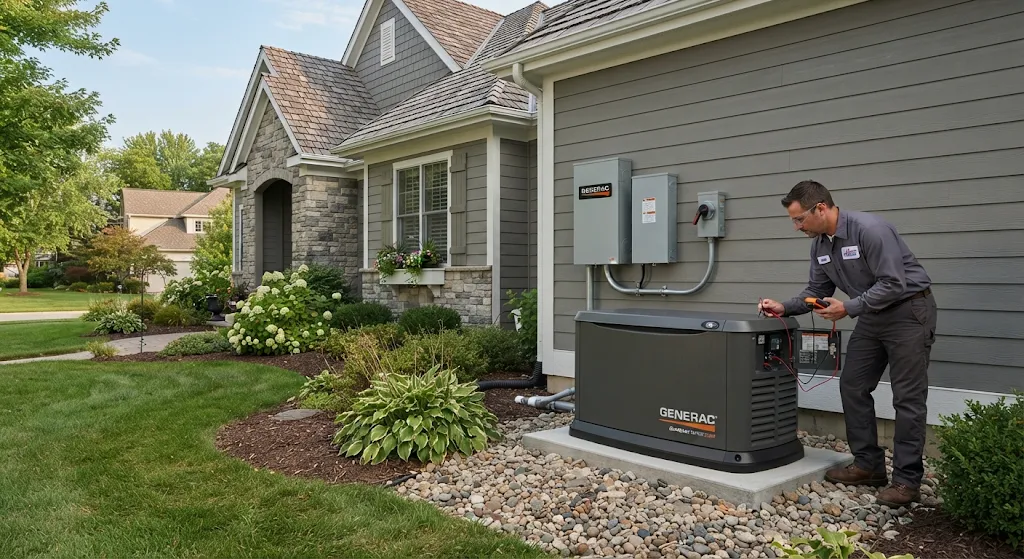
WATT911 connects Fort Wayne homeowners and commercial property managers with independent electrical contractors who specialize in the engineering, load planning, and installation of automatic standby generator systems. Unlike portable generators that require manual outdoor setup, refueling in severe weather, and hazardous extension cords, an automatic standby generator provides seamless, whole-property power restoration within seconds of a utility outage.
Portable vs. Automatic Standby Generation Systems
When considering backup power in Fort Wayne, property owners must understand the operational distinctions between portable units and permanent standby systems:
- Automatic Standby Generators: Permanently installed on an engineered concrete or composite outdoor pad and connected directly to the home's natural gas or liquid propane (LP) fuel supply. An Automatic Transfer Switch (ATS) continuously monitors incoming utility line voltage. When utility voltage drops below acceptable thresholds, the ATS automatically starts the generator engine, safely isolates the property from the utility grid to prevent dangerous backfeeding, and transfers electrical load in under 15 seconds.
- Manual Interlock Kits & Transfer Switches for Portables: For property owners seeking a budget-friendly alternative, independent electricians install a code-compliant manual transfer switch or mechanical interlock plate on your main panel, connected to an exterior power inlet box. This allows safe connection of a portable generator without risking utility backfeed hazards that endanger utility linemen.
Fuel, Setback, and Permitting Requirements in Allen County
Installing a permanent standby generator in Fort Wayne requires strict adherence to local municipal zoning setbacks, fire safety clearances, and mechanical fuel codes. Standby generators must be positioned with adequate clearance from operable windows, doors, and soffit vents (typically a minimum of 5 feet from openings) to prevent dangerous carbon monoxide infiltration.
Your independent electrical contractor will coordinate electrical permits with the Fort Wayne building department, ensure code-compliant flexible fuel connections with your gas utility, and arrange for formal inspection approval upon completion of the installation.
Local Permitting & Code Compliance in Fort Wayne (Allen County)
In the State of Indiana, electrical trade licensing and construction permitting are administered by local municipal building commissions under Indiana Code Title 22. When contracting for Generator Installation in Fort Wayne, independent contractors must register with the local building authority in Allen County, calculate continuous circuit loading under the Indiana Electrical Code (NFPA 70), and obtain formal building permits prior to commencing substantial electrical alterations.
Furthermore, projects requiring utility meter disconnections or transformer de-energization are coordinated directly between the independent contractor and the regional utility serving Fort Wayne (such as AES Indiana, Duke Energy, Indiana Michigan Power, or CenterPoint Energy). Following completion of the work, a local municipal inspector performs an on-site code evaluation to verify grounding electrodes, overcurrent protection, and arc-fault/ground-fault compliance before utility re-energization.
Request Generator Installation in Fort Wayne, IN
Connect with an independent licensed contractor for on-site diagnostics, code-compliant load assessments, and reliable project execution in Allen County.
How to Connect With a Qualified Contractor in Fort Wayne
Taking the next step on your electrical project through WATT911 is straightforward:
- Call our Indiana coordination line at (888) 605-9975 to explain your Generator Installation requirements.
- Our referral desk matches you with an independent contractor serving Fort Wayne who maintains active local registrations and confirmed availability.
- The contractor reviews your project, performs on-site technical diagnostics or load calculations, and issues a written proposal.
- Upon your approval, the contractor pulls required municipal permits, completes the installation in accordance with code, and arranges final inspection.