Residential & Commercial EV Charger Installation in Indianapolis
Electric vehicle adoption is accelerating rapidly across Indiana, and property owners in Indianapolis are increasingly upgrading their electrical infrastructure to support fast, convenient Level 2 charging. While electric vehicles include a standard Level 1 charging cord compatible with a standard 120-volt household outlet, Level 1 charging delivers a sluggish 3 to 5 miles of range per hour—often requiring 24 to 40 hours for a full battery replenishment.
A professionally installed 240-volt Level 2 charging station dramatically reduces charging times, delivering 25 to 45 miles of range per hour. However, adding a continuous 32-amp to 48-amp electrical load requires specialized branch circuit design, dedicated breaker capacity, and comprehensive panel load verification under the Indiana Electrical Code (NFPA 70 Article 625).
Level 1 vs. Level 2 Charging Specifications
Understanding charging equipment capabilities helps Indianapolis drivers select the optimal equipment for their daily commuting requirements:
- Level 1 Charging (120V / 12A-16A): Connects to a standard household outlet on a general branch circuit. Best suited for emergency backup or low-mileage plug-in hybrid electric vehicles (PHEVs).
- Level 2 Dedicated Charging (240V / 32A-48A): Requires a dedicated 40-amp, 50-amp, or 60-amp double-pole circuit routed from the main service panel or a subpanel directly to an EVSE (Electric Vehicle Supply Equipment) unit. Can be installed via a heavy-duty NEMA 14-50 industrial receptacle or hardwired directly into the charging unit for maximum safety and outdoor weather resilience.
Installation Standards & Municipal Permitting in Marion County
Because EV chargers draw continuous high amperage over extended multi-hour durations, improper DIY installations risk severe thermal breakdown, melted terminals, and fire hazards. The Indiana Electrical Code requires:
- Appropriately rated copper conductors (typically 6 AWG or 4 AWG depending on amperage and temperature ratings) housed in code-compliant EMT conduit or armored cable.
- GFCI circuit breaker protection on all 240V EV receptacle outlets.
- Proper torque verification on all terminal connections using calibrated torque screwdrivers to prevent loose, high-resistance heating.
- Formal electrical permits and inspection sign-off from the Indianapolis building commission.
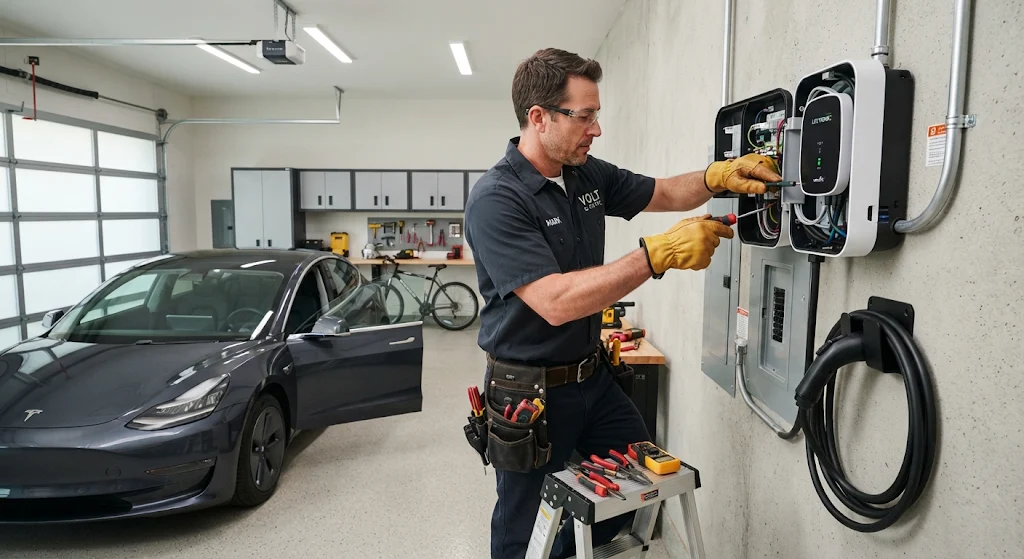
Local Permitting & Code Compliance in Indianapolis (Marion County)
In the State of Indiana, electrical trade licensing and construction permitting are administered by local municipal building commissions under Indiana Code Title 22. When contracting for EV Charger Installation in Indianapolis, independent contractors must register with the local building authority in Marion County, calculate continuous circuit loading under the Indiana Electrical Code (NFPA 70), and obtain formal building permits prior to commencing substantial electrical alterations.
Furthermore, projects requiring utility meter disconnections or transformer de-energization are coordinated directly between the independent contractor and the regional utility serving Indianapolis (such as AES Indiana, Duke Energy, Indiana Michigan Power, or CenterPoint Energy). Following completion of the work, a local municipal inspector performs an on-site code evaluation to verify grounding electrodes, overcurrent protection, and arc-fault/ground-fault compliance before utility re-energization.
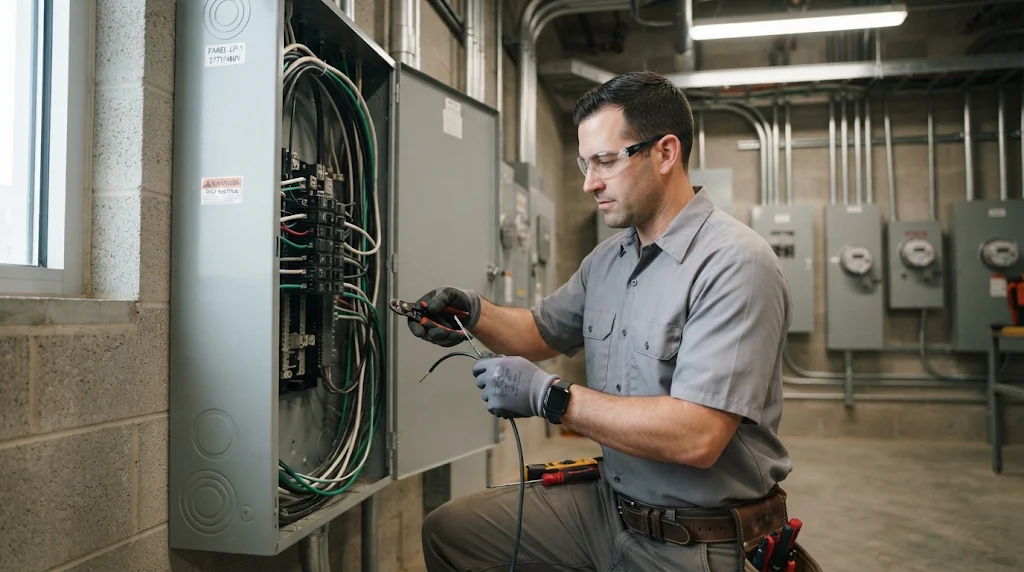
How to Connect With a Qualified Contractor in Indianapolis
Taking the next step on your electrical project through WATT911 is straightforward:
- Call our Indiana coordination line at (888) 605-9975 to explain your EV Charger Installation requirements.
- Our referral desk matches you with an independent contractor serving Indianapolis who maintains active local registrations and confirmed availability.
- The contractor reviews your project, performs on-site technical diagnostics or load calculations, and issues a written proposal.
- Upon your approval, the contractor pulls required municipal permits, completes the installation in accordance with code, and arranges final inspection.