Commercial Electrical Services & Facility Maintenance in Indianapolis
Commercial facilities in Indianapolis—including retail store fronts, office parks, medical clinics, hospitality venues, and logistics centers throughout Marion County—operate under demanding electrical specifications. Commercial power systems must support continuous lighting, sensitive point-of-sale systems, multi-zone HVAC units, server rooms, and life-safety emergency egress systems without interruption or voltage instability.
WATT911 connects business owners, commercial property managers, and general contractors in Indianapolis with qualified independent commercial electrical contractors. These commercial specialists possess the commercial licensing, insurance coverage, and heavy-duty equipment required to execute complex commercial tenant build-outs, power distribution upgrades, and scheduled facility maintenance.
Key Commercial Electrical Capabilities
Participating commercial electrical contractors in Indianapolis provide comprehensive commercial support, including:
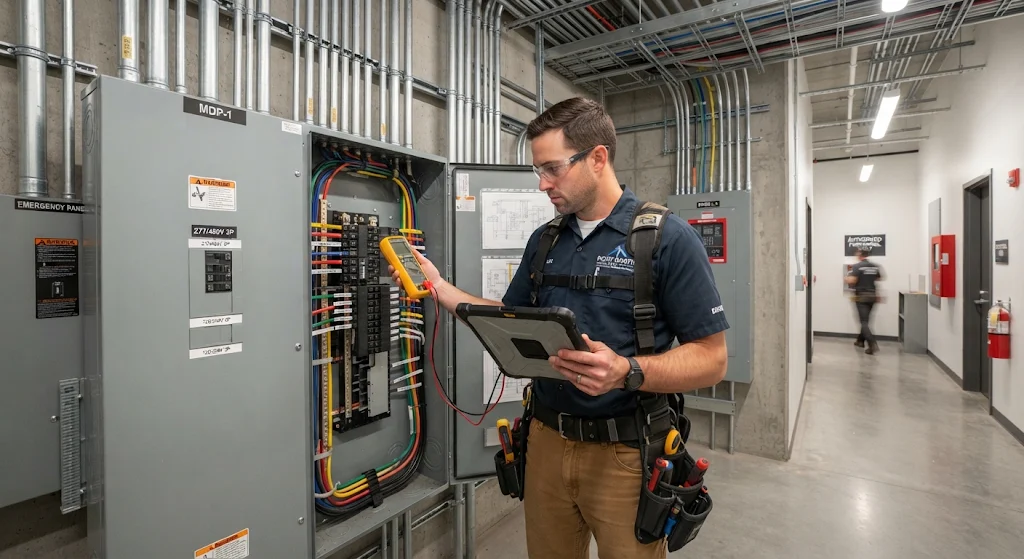
- Commercial Power Distribution & Switchgear: Installation, maintenance, and thermal imaging diagnostics on 120/208V and 277/480V three-phase commercial main distribution panels (MDP), step-down dry-type transformers, and subpanels.
- Tenant Improvements & Commercial Remodeling: Complete branch wiring, dedicated circuits for commercial kitchen equipment, data cabling pathways, and power drops for modular office workstations.
- Commercial LED Lighting Retrofits & Automated Controls: Upgrading inefficient fluorescent, metal-halide, and high-pressure sodium fixtures to high-efficiency LED lighting with daylight harvesting sensors and occupancy controls to lower commercial utility bills.
- Emergency Egress & Exit Lighting Compliance: Routine testing, battery replacement, and installation of illuminated exit signs and emergency egress lighting arrays in full compliance with Indiana fire and building safety codes.
- Dedicated Computer & Server Room Circuits: Installing isolated ground circuits, transient voltage surge suppression (TVSS), and uninterruptible power supply (UPS) connections for sensitive IT hardware.
Commercial Permitting & Code Compliance in Marion County
All commercial electrical alterations in Indianapolis require strict adherence to the Indiana Commercial Building Code and Indiana Electrical Code (NFPA 70). Independent commercial contractors manage all permit filings with the Indianapolis building department, prepare engineering documentation where required, and ensure that all conduit bending, wire pulls, and equipment terminations pass formal commercial electrical inspection before system commissioning.
Local Permitting & Code Compliance in Indianapolis (Marion County)
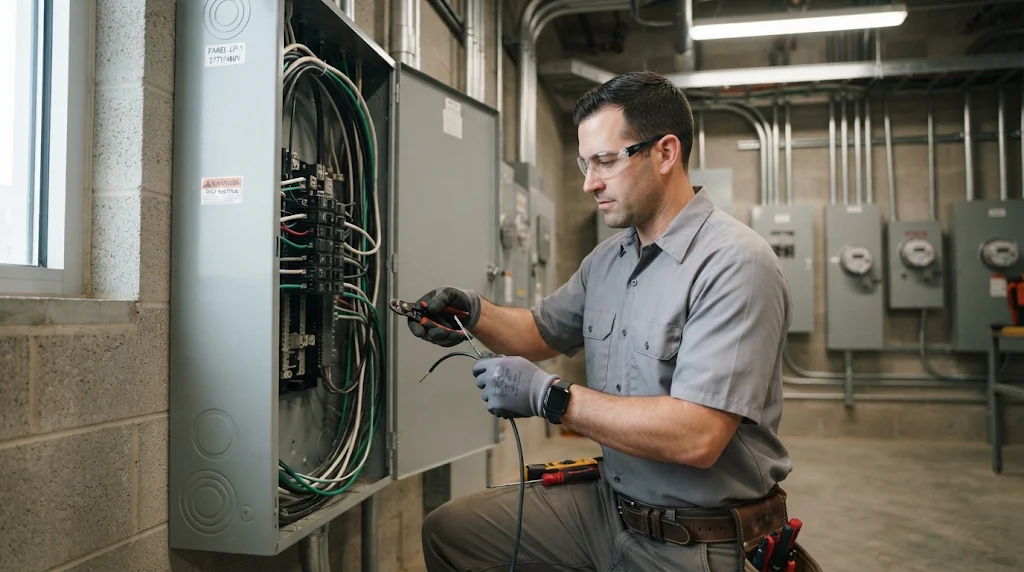
In the State of Indiana, electrical trade licensing and construction permitting are administered by local municipal building commissions under Indiana Code Title 22. When contracting for Commercial Electrician in Indianapolis, independent contractors must register with the local building authority in Marion County, calculate continuous circuit loading under the Indiana Electrical Code (NFPA 70), and obtain formal building permits prior to commencing substantial electrical alterations.
Furthermore, projects requiring utility meter disconnections or transformer de-energization are coordinated directly between the independent contractor and the regional utility serving Indianapolis (such as AES Indiana, Duke Energy, Indiana Michigan Power, or CenterPoint Energy). Following completion of the work, a local municipal inspector performs an on-site code evaluation to verify grounding electrodes, overcurrent protection, and arc-fault/ground-fault compliance before utility re-energization.
How to Connect With a Qualified Contractor in Indianapolis
Taking the next step on your electrical project through WATT911 is straightforward:
- Call our Indiana coordination line at (888) 605-9975 to explain your Commercial Electrician requirements.
- Our referral desk matches you with an independent contractor serving Indianapolis who maintains active local registrations and confirmed availability.
- The contractor reviews your project, performs on-site technical diagnostics or load calculations, and issues a written proposal.
- Upon your approval, the contractor pulls required municipal permits, completes the installation in accordance with code, and arranges final inspection.